
Many homeowners and professionals use cross-linked polyethylene (XLPE) foam insulation to reduce heat transfer, prevent pipe condensation, insulate HVAC ducts, and improve energy efficiency; you will also find it in refrigeration systems, automotive applications, and as sound and vibration damping in walls and floors, offering moisture resistance, easy installation, and long-term thermal performance to protect your building systems and lower operating costs.
Key Takeaways:
- Thermal insulation for pipes, ducts and HVAC systems to reduce heat transfer and lower energy use.
- Refrigeration and chilled-water lines—prevents condensation, frost and thermal bridging.
- Building envelope applications (roofs, walls, floors, under-slab) to improve energy efficiency and indoor comfort.
- Electrical and cable insulation—lightweight, flexible closed-cell foam that protects and simplifies installation.
- Moisture- and vapor-resistant with sound-damping properties for durable, long-lasting performance.
Overview of XLPE Foam Insulation
As you evaluate insulation options for pipes, ducts, or equipment, XLPE foam delivers a closed‑cell, cross‑linked polyethylene solution with thermal conductivity typically 0.032–0.038 W/m·K and densities from about 25–200 kg/m³. You’ll see it used on HVAC and chilled‑water systems, marine applications, refrigeration lines, and cable jacketing because it resists moisture (<3% by volume), recovers from compression, and is supplied in tubes, sheets, and rolls for rapid installation.
Composition and Properties
XLPE forms by chemically cross‑linking polyethylene chains into a three‑dimensional network, giving you a resilient, closed‑cell foam with high dimensional stability. It commonly exceeds 90% closed‑cell content, offers low vapor permeability, and remains flexible across a wide service range (roughly −40°C to +90°C). Densities and cell sizes vary by grade so you can choose lightweight (≈25–50 kg/m³) or more robust (≈100–200 kg/m³) formulations for different mechanical demands.
Advantages of XLPE Foam
You gain low thermal conductivity, strong moisture resistance, and good mechanical recovery that together reduce condensation and thermal loss in installations. It’s lightweight, easy to cut and bond with adhesives, and available in pre‑formed tube sizes (commonly covering 6–89 mm nominal pipe diameters) to speed installation. Manufacturers often expect service lives of 20+ years in protected HVAC applications when UV exposure is avoided.
For practical selection, typical thicknesses range from 6–50 mm: installers commonly use 12–25 mm for chilled‑water lines to prevent sweating and 9–25 mm for hot‑water runs to limit heat loss. You can specify UL or EN fire performance variants—many formulations are produced to meet ASTM E84 or EN 13501‑1 classifications. Also, the closed‑cell structure keeps water uptake low, so your installed R‑value holds up well over time.
Applications in Construction
You’ll find XLPE foam used across building envelopes where thermal control, moisture resistance and lightweight handling matter. With thermal conductivity around 0.035–0.040 W/m·K and an approximate R-value near R‑4 per inch, it’s specified for wall cavity inserts, roof underlayments and pipe insulation; consult How does XLPE foam help the construction industry? for project examples and product selection guidance.
Thermal Insulation
For HVAC, plumbing and building envelopes you’ll use XLPE in thicknesses from about 6–50 mm depending on duty; its low thermal conductivity makes it effective as a thermal break and vapor-retarder. Designers commonly specify 10–25 mm for ductwork and 19–25 mm for chilled-water lines to limit condensation and heat gain, and its closed-cell structure helps maintain consistent performance over long service lives.
Acoustic Insulation
You can deploy XLPE as underlayment, partition backing and pipe vibration padding to reduce airborne and structure-borne noise. Typical floor underlayments (3–10 mm) deliver impact-sound reduction and, when paired with floating floors, often improve STC/ IIC ratings by 3–6 points depending on build-up and density.
In practice, you’ll see XLPE combined with denser layers—mass-loaded vinyl or cementitious toppings—to target low frequencies; it also isolates mechanical equipment, where adding a 10–20 mm pad under pumps or ducts measurably lowers vibration transmission into building structure and adjacent rooms.
Uses in HVAC Systems
Duct Insulation
XLPE foam is used to insulate rectangular and spiral ductwork to reduce thermal transfer and airborne noise; with thermal conductivity around 0.035–0.04 W/m·K (about R‑4 per inch) you typically choose 6–25 mm (1/4–1″) thickness for internal ducts and thicker wraps for exterior runs. You’ll often pair it with foil facings for vapor control, which helps prevent condensation on chilled-air ducts in humid climates and improves system efficiency.
Pipe Insulation
On chilled, hot and refrigerant lines you use XLPE tubes and split jackets for condensation control and heat retention; common thicknesses are 9–25 mm (3/8–1″) for residential systems and 19–50 mm for commercial applications. Because XLPE is closed‑cell with low water absorption (<1% by volume) and an operating range near −50°C to +90°C, it helps prevent corrosion under insulation and maintains thermal performance over time.
You’ll install XLPE as pre‑slit tubes, slip‑on sleeves or wrapped mats, selecting factory‑applied adhesive or self‑sealing seams to speed fitment; seal butt joints with compatible tape or mastic and avoid compressing the foam at hangers to preserve R‑value. For extended chilled‑water runs follow ASHRAE thickness guidance, add UV‑resistant jacketing outdoors, and schedule visual inspections to catch damage or moisture intrusion before it affects system performance.
Automotive Applications
You encounter XLPE foam across modern vehicles for thermal management, NVH reduction and sealing tasks; manufacturers commonly specify densities of 25–200 kg/m³ and thicknesses from 3–25 mm for different zones. It appears in door liners, headliners, trunk pads, under-hood shields and battery enclosures, where its closed-cell structure limits moisture ingress and outgassing. Engineers select grades rated up to about 120°C (depending on formulation) to protect wiring, plastics and electronics while keeping weight down compared with mineral-based insulators.
Under-hood Insulation
Under the hood, you use XLPE foam as heat shields, engine bay gaskets and intake silencers; typical parts are 5–25 mm thick and often laminated with foil or heat-reflective facer. It withstands short-term peaks near 120°C for many grades and reduces heat transfer to nearby harnesses and sensors, extending component life. Suppliers deliver die-cut pieces and molded shapes that meet automotive outgassing and flammability specifications when properly formulated.
Interior Cabin Insulation
For the cabin, you deploy XLPE foam in door panels, dash insulators, floor mats and headliners to improve acoustic damping and thermal comfort; common thicknesses are 3–12 mm with densities around 30–150 kg/m³. It lowers road and wind noise by attenuating mid- to high-frequency energy and acts as a vapor barrier to protect trims and electronics. OEMs often combine it with adhesives or mass-loaded layers for targeted NVH tuning.
Installation-wise, you can get XLPE parts as PSA-backed gaskets, die-cut blanks or laminated assemblies; manufacturers often use acrylic pressure-sensitive adhesives, hot-melt bonding or thermal welding for reliable attachment. It resists water, oils and common automotive chemicals, so your cabin panels stay dimensionally stable and mold-free, and you can stack or tune layers to hit specific Sound Transmission Class or frequency-band targets during validation testing.
Electrical Applications
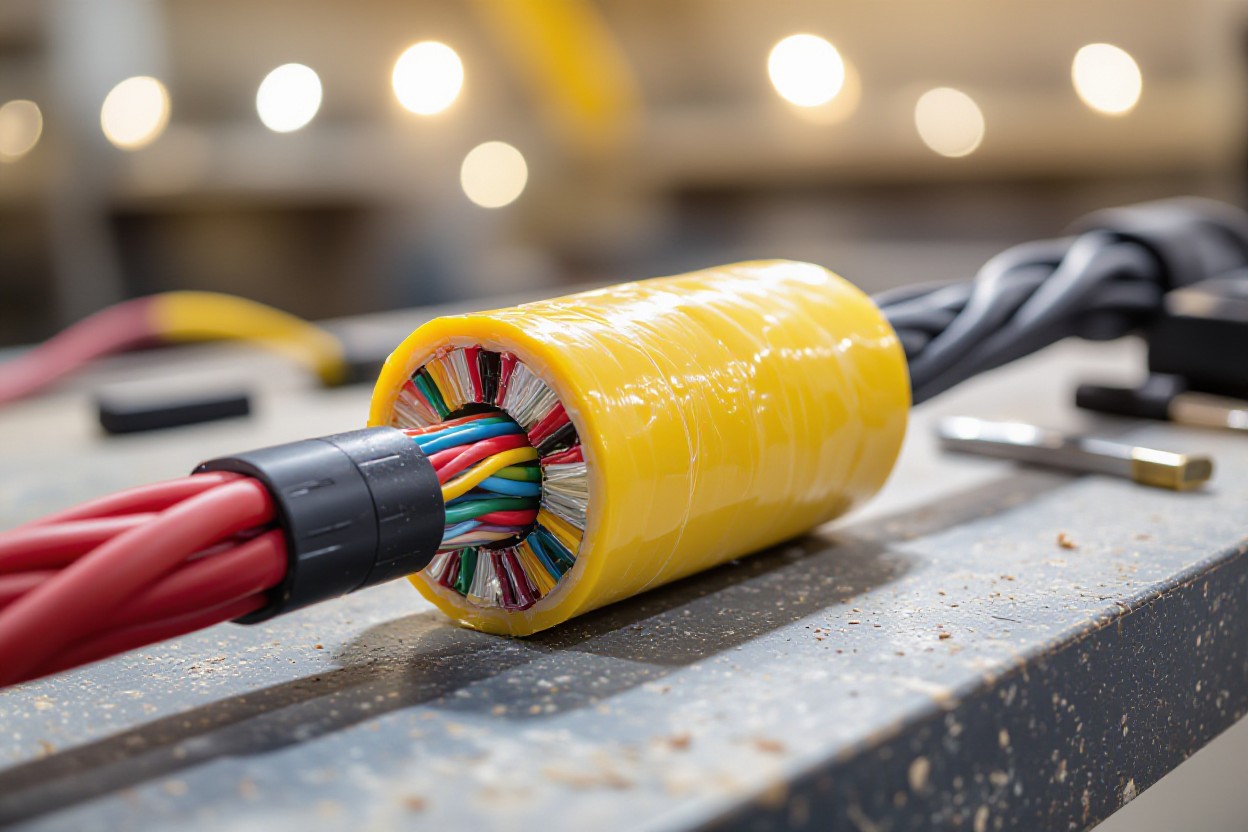
XLPE finds wide use where you need high-performance electrical insulation: it’s specified for power cables from 1 kV up to 500 kV, offers continuous operation around 90°C with short-circuit survivability up to ~250°C, and resists dielectric aging and moisture ingress. For detailed material properties, standards, and installation guidance consult Cross-Linked Polyethylene (XLPE): Benefits & Applications, which you can use to match XLPE grades to your project requirements.
Cable Insulation
You use XLPE for cable insulation because it combines low dielectric loss with strong thermal and mechanical stability; it’s the industry choice for medium- and high-voltage underground and submarine cables, distribution feeders, and IEC-standard power lines, where insulation thickness varies depending on voltage class and conductor size and installers rely on its lower propagation of water-treeing compared with traditional PE.
Electrical Component Protection
You apply XLPE as insulation for transformer leads, motor windings, busbars, and switchgear barriers where thermal cycling, solvent resistance, and abrasion protection matter; manufacturers often mold XLPE sleeves or potting blocks to isolate live parts and reduce risk of creepage and tracking.
In practice you benefit from XLPE’s resistance to partial discharge and chemical attack—standards like IEC 60840 and IEC 62067 guide design for MV/HV systems—while crosslinking methods (peroxide or silane) and compatible termination accessories affect long-term performance. For installation you should account for heat-shrink or cold-shrink jointing, proper curing during manufacturing, and compatibility with joint compounds so your assemblies meet dielectric tests and service-life expectations.
Sustainability and Environmental Impact
Because XLPE foam has low thermal conductivity (around 0.033–0.040 W/m·K), you can reduce annual heating and cooling loads when it’s applied correctly; its service life often exceeds 25 years in building and HVAC installations, which lowers lifecycle environmental impact. Manufacturers increasingly adopt closed-loop processes to cut production waste, so your specification of XLPE typically means fewer replacements, steadier performance and lower embodied carbon per year of service.
Recyclability of XLPE Foam
Because XLPE is chemically cross-linked, you cannot remelt and re-extrude it; recycling relies on mechanical routes such as shredding into crumb for use as filler, bonded mats or underlayments. If you generate offcuts, many suppliers run take-back programs or divert material to energy recovery—polyethylene-grade materials yield roughly 40–46 MJ/kg—thus avoiding landfill and recovering value from production waste.
Eco-friendly Advantages
With a closed-cell structure that keeps water absorption very low (often under 1% by volume), XLPE foam helps you avoid moisture damage and mold, extending asset life and reducing replacement frequency. Its durability—commonly over 25 years—translates into lower lifecycle emissions, and many low-VOC formulations reduce indoor-air impacts when you specify them in occupied spaces.
You can quantify those advantages: energy recovery at end-of-life is about 40 MJ/kg, and amortizing manufacturing emissions over a 25–30 year lifespan significantly lowers embodied carbon per service-year. In industry practice, many facilities divert over 70% of production scrap into reuse or energy recovery, so when you choose XLPE for long-life HVAC, plumbing or equipment insulation you cut both operational energy and maintenance-related waste streams.
Conclusion
Now you rely on XLPE foam insulation for thermal and acoustic control in HVAC, refrigeration, and pipework, as well as for moisture-resistant, closed-cell protection in buildings, automotive, and marine systems; its low thermal conductivity, electrical insulation, vibration damping, and ease of installation make it a versatile choice for both commercial and residential applications.
FAQ
Q: What is XLPE foam insulation?
A: XLPE foam (cross‑linked polyethylene foam) is a closed‑cell, lightweight polymer foam produced by cross‑linking polyethylene chains. It offers low thermal conductivity, high moisture resistance, good compressive strength, chemical resistance, and dimensional stability. Available in sheets, tubes, and rolls, it is flexible, durable, and often supplied with self‑adhesive backing or protective facings for easy installation.
Q: What building and HVAC applications is XLPE foam insulation used for?
A: In buildings and HVAC systems XLPE foam is widely used to insulate hot and cold water pipes, chilled water lines, refrigerant lines, ductwork, and equipment housings. It minimizes heat loss/gain, prevents condensation and mold on cold surfaces, reduces energy consumption, and helps maintain system efficiency. Its flexibility and adhesive options make it suitable for retrofits and tight spaces.
Q: Can XLPE foam be used for acoustic and vibration control?
A: Yes. XLPE foam provides sound absorption and vibration damping in mechanical rooms, HVAC plenums, wall and ceiling assemblies, and around pumps and compressors. Its closed‑cell structure reduces airborne noise transmission and its resilience attenuates structure‑borne vibrations, improving occupant comfort and equipment longevity.
Q: Is XLPE foam appropriate for refrigeration and low‑temperature applications?
A: XLPE foam performs well in refrigeration and cold storage environments because it resists water absorption, maintains thermal performance at low temperatures, and inhibits condensation and frost build‑up on piping and surfaces. Its closed‑cell makeup reduces vapor transmission, lowering the risk of corrosion under insulation when properly installed with vapor barriers where required.
Q: What industrial, marine, packaging, and specialty uses does XLPE foam have?
A: Industrially, XLPE foam is used for insulating process piping, cryogenic lines, and equipment enclosures. In marine and automotive sectors it serves as flotation material, vibration padding, interior trim, and protective decking. It is also used for shock‑absorbing packaging, protective cases, gaskets, seals, and sports padding. Its chemical resistance, durability, and ease of fabrication make it versatile across many specialty applications.