
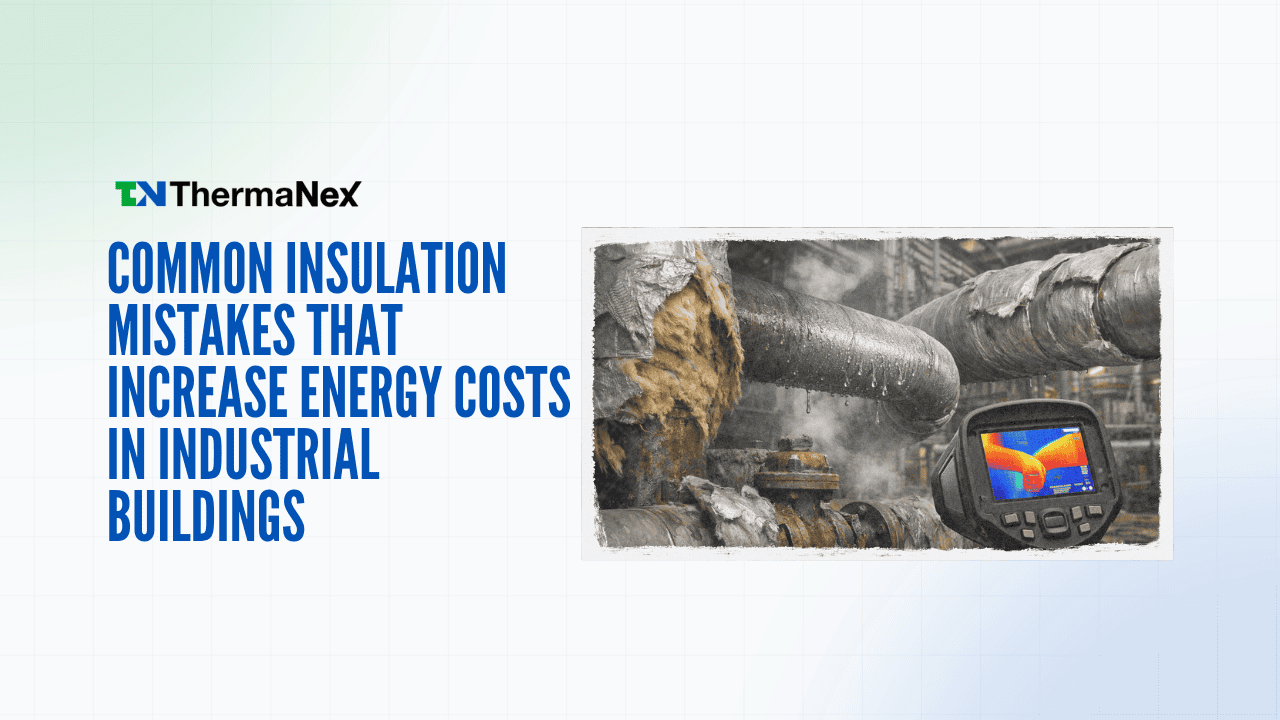
Many industrial facilities underestimate how small insulation errors drive up energy bills; when you allow gaps, compress insulation, or select improper materials, your heating and cooling systems work harder, maintenance rises, and operational costs climb. By diagnosing thermal bridges, ensuring correct thickness and continuous vapor control, and training staff on installation and repairs, you can lower energy waste and protect equipment performance.
Key Takeaways:
- Air leakage and gaps at joints, penetrations, doors, and roof seams create thermal losses and negate insulation value, driving up heating and cooling loads.
- Wrong insulation type or insufficient thickness (compressed or improperly installed) and thermal bridging reduce R‑value and increase energy consumption.
- Poor maintenance-damaged, wet, or missing insulation and uninsulated valves, flanges, ducts, and pipes-degrades performance and raises operating costs.
Common Insulation Mistakes
Most energy losses you face come from avoidable errors: continuity breaks, wrong thickness, and poor sealing, which can raise energy costs by 10-25% in industrial settings. For practical repair pitfalls and solutions consult 4 Common Mistakes to Avoid with Commercial Insulation … to compare common failure modes and straight fixes you can apply on-site.
Inadequate Insulation Thickness
When you under-spec insulation, you let thermal loads climb: roofs often need R‑30 to R‑50 and exterior walls R‑13 to R‑21 depending on climate zone and process heat; falling short increases HVAC runtimes and can raise energy use by double digits. Use project-specific heat-loss calcs and match installed thickness to the design R‑value rather than relying on “typical” thicknesses.
Poorly Sealed Joints and Penetrations
Unsealed joints, pipe penetrations, and access doors are common leakage paths; air leakage through these points can account for 20-30% of envelope losses in poorly detailed buildings. You should prioritize sealing at penetrations, transition points, and mechanical passthroughs with compatible tapes, mastic, or gasket systems to cut uncontrolled drafts and moisture entry.
For deeper fixes, perform smoke or infrared testing to locate leaks, then use elastomeric mastic for irregular gaps, butyl or butyl-backed tape for sheet overlaps, and preformed pipe collars for service penetrations; ensure vapor barrier continuity and back up seals with mechanical fasteners where thermal cycling is severe. Pressure testing before cladding closure verifies you’ve reduced leakage to target thresholds.
Incorrect Installation Practices
Compressing batt insulation into undersized cavities, leaving gaps at studs, or installing insulation with voids reduces effective R‑value-compression can cut rated performance by 20-50% and thermal bridging through metal fasteners or studs compounds the loss. You must install to manufacturer spacing and avoid crushing, compressing, or leaving voids around fixtures and conduits.
To prevent these errors implement simple QA: require mock-up sections, provide installer training, perform spot checks on 10-20% of installed areas, and use infrared scans after occupation. Following manufacturer guidelines for fastener patterns, joint overlaps, and vapor retarder placement reduces rework and preserves the designed energy savings.
Identifying Energy Loss
You should focus on measurable gaps where conditioned air escapes: roofs, walls, doors, and pipe penetrations often account for 20-35% of wasted energy in older industrial sites. Use meter trends to spot abnormal HVAC runtimes, compare energy intensity (kWh/ft²) against benchmarks for your industry, and target areas that show repeated temperature swings or condensation-these are where insulation failures most commonly drive up fuel and electricity costs.
Signs of Inefficient Insulation
You can spot inefficient insulation by uneven interior temperatures, persistent condensation or mold on walls, and drafty loading docks; these often coincide with 10-30% higher HVAC runtimes. Visible sagging, compressed batts, and cold spots on pipes or ducts indicate compromised R-values. Track monthly energy bills and equipment cycles-spikes after maintenance or renovations frequently point to newly exposed thermal bridges or improperly reinstalled insulation.
Utilizing Thermal Imaging
You should deploy thermal imaging to map temperature differentials across envelopes, ductwork, and equipment, revealing hidden voids and thermal bridges. Handheld cameras range from a few hundred dollars to professional units; contractors using professional cameras typically identify insulation defects invisible to the eye, often locating gaps responsible for 5-20% of localized heat loss. Capture images during stable conditions for best results.
For effective thermal surveys you must scan when indoor-outdoor temperature differences exceed about 10°C (18°F) to maximize contrast; perform roof and wall scans early morning for solar-neutral results. Adjust emissivity for metal surfaces, avoid reflections that create false positives, and corroborate findings with moisture meters or borescope inspections. When operators document each anomaly with annotated images and GPS coordinates, retrofit crews can prioritize fixes that frequently yield 5-15% energy savings within a single heating season.
Cost Implications of Poor Insulation
Poor insulation drives multiple line-item increases on your operating budget: higher fuel and electricity consumption, more frequent maintenance, and accelerated capital replacement. You can expect energy bills to climb by roughly 10-30% in facilities with widespread insulation failures, while retrofit projects typically return investment within 2-4 years through energy and maintenance savings.
Increased Energy Bills
When thermal envelopes leak, your HVAC and process systems work harder: industrial sites commonly report 10-25% higher heating or cooling energy use from insulation gaps or degraded materials. For example, a 100,000 ft² warehouse with damaged roof insulation saw about $35,000 extra annual gas and electric costs until repairs were completed, highlighting the direct budget impact.
Impact on Equipment Performance
Insulation failures raise equipment stress by changing operating temperatures and increasing cycling, which lowers efficiency and shortens service life. You may see compressors and boilers operate 5-15% less efficiently, and bearings or heat exchangers fail sooner due to thermal shocks and condensate-related corrosion, driving up repair and replacement frequency.
In practice, uninsulated or poorly insulated steam lines, tanks, and ductwork create hot or cold spots that force controls to compensate continuously. One plant audit found that insulating neglected steam mains reduced fuel use by 12% and extended boiler maintenance intervals, translating into both immediate energy savings and fewer emergency shutdowns for equipment repairs.
Best Practices for Efficient Insulation
You should prioritize continuous insulation, correct R-values, and thermal breaks; for industrial roofs aim for R-30-R-60 and for walls R-15-R-30 depending on process loads. Combine air barriers, vapor control, and mechanical insulation on pipes and ducts-insulating steam lines with 2 in (50 mm) of mineral wool can cut heat loss by ~25%. Use thermal imaging every 1-3 years to spot thermal bridging and compressed batts, and seal penetrations to prevent convective loops and moisture ingress.
Regular Insulation Audits
You should schedule audits every 12-36 months based on exposure and process sensitivity; include IR scans, targeted R-value checks, and blower-door tests for enclosed plant areas. In a 2019 industry survey, targeted repairs after audits reduced HVAC energy use by 12-18% within six months. Track insulation age, mechanical damage, and wet zones to prioritize repairs and replacement cycles.
Professional Installation Tips
You should require installers certified in industrial insulation and enforce tight tolerances-seal seams within 5 mm and avoid compressing batt materials more than 5-10%. Insist on corrosion-resistant jacketing for outdoor lines and specify ceramic-fiber blankets for surfaces above 650°C. Include a QA checklist with photos, torque specs for fasteners, and manufacturer-approved adhesives to prevent premature failure.
- Specify materials by thermal conductivity and service temperature, not just brand.
- Require mock-up sections for complex penetrations and HVAC plenum tie-ins.
- Keep an on-site record of batch numbers and cure times for adhesives and mastics.
- Thou must verify installers adhere to manufacturer installation schedules and curing windows.
You should also monitor installation effects: measure post-installation surface temperatures and calculate achieved U-values versus design targets, ensuring pipe insulation compression stays below 10% since excess compression can reduce R-value significantly. Opt for factory-clad removable sections where frequent access is needed, demand a minimum 5-year workmanship warranty, and schedule a 12-month recheck to catch settlement or moisture intrusion.
- Perform a follow-up thermal scan at 3-12 months to catch early defects.
- Enforce documented cleanup and vapor barrier restoration after penetrations.
- Use tamper-evident seals and label insulated runs with dates and R-values.
- Thou shall require remediation of defects within 30 days of discovery.
Regulatory Standards and Compliance
When you assess insulation, follow ASHRAE 90.1 and locally adopted IECC requirements, because noncompliance forces costly rework and failed inspections; consult practical guidance such as 5 mistakes when selecting industrial insulation to avoid specification errors and ensure documented U‑values, R‑values, and continuous insulation details are in your submittals.
National Energy Codes
In the US, you must reference ASHRAE 90.1 and the IECC where adopted; these set minimum thermal performance, U‑factor and R‑value targets by climate zone (1-8) and often require documented calculations and assemblies. Failure to list continuous insulation, vapor control, or required R‑value in submittals frequently triggers RFIs and inspection holds that delay commissioning.
Industry Best Practices
You should prioritize materials rated for operating temperatures and moisture conditions-e.g., closed‑cell foam for damp areas and mineral wool or calcium silicate for high‑temperature lines-and specify thickness to meet or exceed code R‑values, accounting for thermal bridging and penetrations during design reviews.
For example, thermal bridging can lower system performance by 20-30% and compressed batt insulation can lose up to 50% of its declared R‑value; insist on pre‑installation mockups, infrared acceptance scans, and contractor training so insulation continuity, vapor barriers and jacketing are correctly installed to preserve expected energy savings.
Conclusion
Upon reflecting you see that common insulation mistakes-gaps, compressed or misinstalled insulation, incorrect R-values, thermal bridges, unsealed penetrations, moisture damage, and neglected maintenance-drive up your energy costs in industrial buildings. By prioritizing proper material selection, correct installation, thorough sealing of joints and penetrations, and routine inspections, you can reduce heat loss, lower operating expenses, and extend system lifespan.
FAQ
Q: What common installation mistakes cause the biggest increases in energy costs for industrial buildings?
A: The most impactful installation errors are incomplete coverage, gaps at seams and penetrations, and compression of bulk insulation. Missing insulation on short runs of piping, valves, flanges and duct joints creates localized heat loss that forces HVAC and process systems to run longer. When blanket or batt insulation is compressed under hangers or clamped too tightly it loses much of its rated R-value. Thermal bridging through unbroken metal supports, structural members, or poorly detailed joints bypasses insulation entirely. These faults increase fuel and electricity consumption, raise line losses, and can upset process control. Fixes include full-coverage specifications, sealed butt joints and lap overlaps, proper hanger spacing and pads to prevent compression, and use of thermal breaks or continuous insulation details where metal bridging is unavoidable.
Q: How do moisture and improper vapor control in industrial insulation lead to higher energy use and equipment problems?
A: Incorrect or absent vapor barriers and damaged jacketing allow water intrusion, which dramatically lowers the effective R-value of many insulation materials and creates wet, conductive paths for heat flow. Trapped moisture also leads to corrosion under insulation (CUI) on piping and tanks, which can cause insulation loss, leaks and unplanned shutdowns. Wet insulation is heavier, sags, and degrades faster, requiring more frequent replacement and increasing thermal losses in the meantime. Prevention requires selecting vapor-retardant systems appropriate to the climate and process, ensuring continuous and sealed jackets, providing drainage and drip details, using closed-cell or hydrophobic insulations where needed, and scheduling inspections and repairs after any roof or jacket damage.
Q: Why does choosing the wrong insulation material or thickness raise long‑term operating costs, and how should owners avoid that mistake?
A: Undersized R-values or materials mismatched to operating temperatures, chemical exposure, or site conditions deliver poor lifecycle performance. Low initial cost materials can age faster, lose insulating properties under UV or moisture exposure, or degrade at high operating temperatures, increasing energy consumption and replacement frequency. Overinsulating without addressing air infiltration or thermal bridges also yields diminishing returns. Avoid these pitfalls by performing a lifecycle cost analysis rather than a first‑cost decision, specifying insulation compatible with maximum service temperatures, moisture and chemical exposure, and using manufacturer data for aged thermal conductivity. Validate design with thermal modeling and periodic thermographic surveys after installation to confirm performance and identify areas for targeted retrofit (increasing thickness, replacing with higher‑performance materials, or adding continuous cladding and thermal breaks).